Saturday, December 12, 2015

Lady Macbeth's Ideal Saturday Night

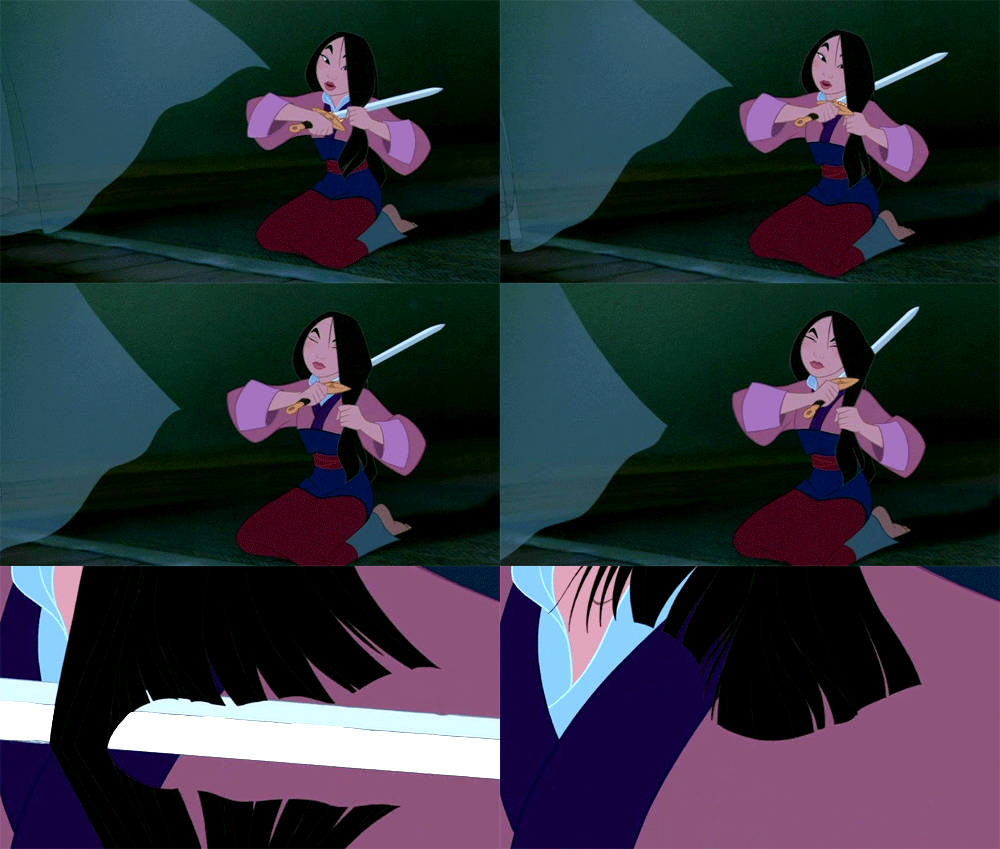
Mulan
Lady Macbeth would love this movie because Mulan does what Lady Macbeth wishes she could do: Mulan turn into a guy. Lady Macbeth's famous speech reveals that she herself wishes she could turn into a man so she could commit murder. Lady Macbeth would be able to connect with Mulan because of their identical strong willpower to do what they want and not let others stop them.


How to Get Away with Murder
Lady Macbeth would originally watch this to figure out how she could get away with the murder of King Duncan. However, she would continue watching as the plot thickens in the show, as well as in her own life. Lady Macbeth would love the drama that begins occurring in the life of Viola Davis and would use it to escape the guilt she is beginning to feel about the murders she has helped commit.


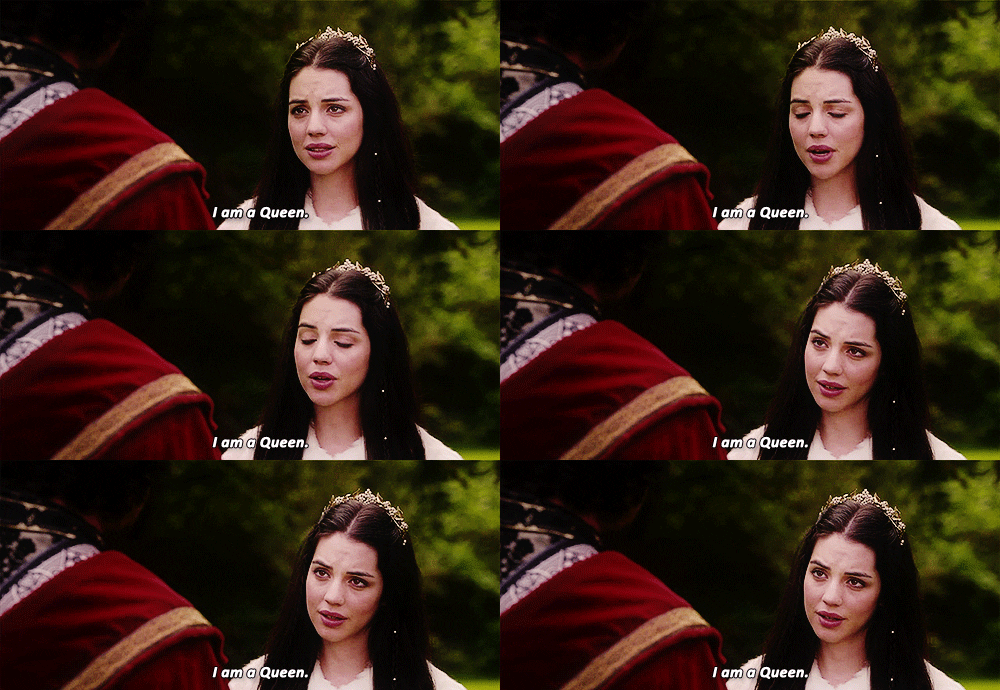
Reign
Lady Macbeth would love this show because of the strong female character of Queen Mary, but also because of the stories of royalty. The love triangle in the show would amuse Lady Macbeth, but the real appeal would be the character of Queen Mary herself. Queen Mary is very decisive and makes sure she gets what she wants, just like Lady Macbeth.


Legally Blonde
Elle Woods would be Lady Macbeth's favorite character ever. Lady Macbeth would adore Elle's independence and her ability to do anything and everything a man could do. Elle does this all while keeping her femininity as well. Elle even gets into Harvard Law School! She does this and more which Lady Macbeth would love to do.


Leap Year
Once again, the strong female character of Anna Brady would appeal to Lady Macbeth. Anna Brady takes life into her own hands when she goes to Ireland to propose to her boyfriend. This gets interrupted by a handsome stranger she meets along the way. It is very obvious that Anna wears the pants in her relationship, just like Lady Macbeth does in her marriage to Macbeth. 

Sunday, November 22, 2015

"All things truly wicked start from an innocence" - Ernest Hemingway

https://38.media.tumblr.com/761e20abdb9e468c3accfb3603720562/tumblr_inline_ncsp86wSid1sxlyin.gif


When we think of evil, we automatically envision the worst of the worst. So why is it that someone who is good would choose evil? Maybe they believed it would be easy. Maybe they believed it wouldn't lead to more evil. Maybe they did not choose evil. Maybe someone else made that choice for them and they were too weak to argue. 

In Macbeth, it is evident that Macbeth did not take his first step on his own. His step was heavily encouraged by someone very close to him: his wife. The Wyrd Sister say to Macbeth, "All hail, Macbeth , that shalt be King hereafter!" (Macbeth, 1.3). Of course, Macbeth had to tell his wife about this amazing prophecy and, once he writes to her, we hear Lady Macbeth's response. She wants more than anything for Macbeth to get the power he has been told he will receive. Macbeth wants this power as well, but he wishes to hang onto his morals and refuses to kill King Duncan... at first.

By the end of Act I, Macbeth is already beginning to take his first steps toward evil. His first step isn't killing Duncan, his first step is deciding to kill Duncan. However, as I already stated, Macbeth does not make this decision on his own. Lady Macbeth is there doing all she can to convince Macbeth to kill Duncan. She even says, "I would, while it was smiling in my face,/ Have plucked my nipple from his boneless gums/ And dashed the brains out" (Macbeth, 1.7). Having your own wife say that she would kill her own child for power makes it easier to think of killing someone unrelated to you for power. At least, that's how Macbeth sees it.

So maybe someone good only becomes evil through other people's persuasion. Still, what happens to these good-turned-evil people? I can only imagine that they don't end up very happy. If you have morals, then I'm sure being evil wouldn't make you feel good. Once again, this is shown through Macbeth as he continues traveling down the road to evil.

Immediately after killing King Duncan, Macbeth feels guilty. He asks, "Will all great Neptune's oceans wash this blood/ Clean from my hand?" (Macbeth, 2.2). Over time, this murder seems to matter less and less to him, until he murders again. This time, he is not the direct murderer, but he calls for the murder to be done. He gives the order for his best friend, Banquo, to be killed. After this, he begins seeing Banquo's ghost and, essentially, he goes insane.

So, to recap, good people don't become evil without a push from someone else, and, once they are evil, they literally go crazy from guilt.

Sunday, November 8, 2015

I Really Can't Draw

http://www.metmuseum.org/toah/works-of-art/20.151.6

This painting is entitled "Walter Devereux (1539-1576), First Earl of Essex" and was painted using oil on wood by a British painter in 1572. The size of the painting is 41 1/8 inches by 31 1/2 inches. Walter Devereux was named the Earl of Essex in 1572, the same year this painting was done. That same year, he was also installed as a Knight of the Garter. The identity of the painter is unknown as there is not enough evidence to come to a sure conclusion. The painting is British in origin and was done while Elizabeth I was in power. 

Walter Devereux is the main subject of the painting, as the portrait was done to commemorate his rise in power. There is also a crest for the Knights of the Garter seen in the upper left hand corner with an inscription meaning "Shame on him who thinks evil". In the upper right hand corner there are more inscriptions meaning "Envy is the companion of virtue". A knight's helmet can be seen in the bottom right hand corner as well. 

The first thing I noticed about this painting was the amount of gold in it. The painter uses gold to write inscriptions as well as to draw complicated designs on Devereux's armor. When I first saw the image, I already knew the man was of importance because of the enormous amounts of gold. The fact that the detailing is so intricate also brought my attention as I knew someone of lesser status would not have such a detailed painting, if any painting. Devereux's legs are not included in the painting, which I believe is important to note as it puts the entire focus onto Devereux's upper body. Now, Devereux's upper body is covered in armor, which means that the artist meant to draw attention to the armor all along. This makes sense because, as I stated before, this painting was meant to celebrate Devereux's new position in the Knights of the Garter. 

Status was very important in the 1500's as the nobility had all of the power. At the time of this painting, Walter Devereux had just been installed as a Knight of the Garter, as well as the Earl of Essex, meaning that he just rose significantly in status. He gained the title of Knight because of his faithfulness to Elizabeth I. This shows the sheer power of the nobility because Devereux was given a title for being loyal to a royal. Devereux's new power can be seen in his posture, as it is very straight with a hand on a helmet. Te painter did this in order to show Devereux's power. If the helmet and armor aren't enough to show the purpose of the painting, the sign of the Knights of the Garter does. The appearance of the crest makes it known that this man is in favoritism of the Queen and is, therefore, someone that should be listened to. 

P.S. I actually did try really hard on my sketch and I'm honestly a little proud of it, so please enjoy!


http://www.metmuseum.org/toah/works-of-art/20.151.6

http://www.metmuseum.org/collection/the-collection-online/search/33284?=&imgno=0&tabname=label

http://www.metmuseum.org/toah/ht/?period=08&region=euwb#/Key-Events

Sunday, October 25, 2015

Yay for Plays!

I have a freebie from the play! And I have to say that the play was awesome! As an insane theatre geek, I loved it. Thank you so much for inviting us, Mrs. Genesky!!

Sunday, October 11, 2015

freebie (I've got a huge theatre presentation and college apps)

Sunday, September 27, 2015

The Name Game

https://www.pinterest.com/pin/299489443943330412/

I have known the meaning of my name ever since I was a little girl. I remember looking up my friends' names online all the time to find the meaning of them. The name "Amy" is French in origin, which makes me very glad that I decided to learn French. It comes from the verb "aimer" which means to like or to love, so it is no surprise to me that my name means "beloved". I have always loved being around my friends and family because I know that I am around people that I love and that love me as well. I get my energy from knowing that I have people who love me, no matter how quirky I know I can be. I love my name because I feel as if it shows what I want to be, which is beloved by many.

My personality changes all the time depending on who I am with. I have always been talented at slightly tweaking my personality to fit whatever group of people I happen to be with. There are times, however, that my personality can take a huge turn. I can be extremely quiet and shy when I am in a group of strangers or acquaintances, but when I am with a close group of friends or my family I am known to get very talkative and a little hyper. I am defined by both of these personalities because, even though they are different, they are both a part of me as a whole. I never feel as if I have to "choose" which Amy I want to be, because I know that I am still myself no matter which side of myself I am showing.

Sunday, September 13, 2015

Covering Othering

http://know.wingyounghuie.com/post/21190069635

This photograph, taken by Wing Young Huie and titled Walter, can be seen in Huie's collection We are the Other. It was published in 2012 on Huie's blog and shows a boy sitting on a bench holding a sign that says "Equality For the Undocumented" in South Minneapolis, Minnesota.

The image is in black and white which might appear fancy, but the setting of the photo is relatively average. There's no flashy backdrop or special clothes. You can see a boy wearing casual clothes, a bench, a wooden pole, some plants, and the sidewalk. None of these objects are out of the ordinary other than the sign. 

Looking deeper, however, you can see that this picture has a lot of meaning. The boy is not famous in any way. This brings out the meaning of the sign. Though this boy is undocumented and unknown, he still wants to be treated like a person. So many other people share this wish which is why this picture is actually really important. 

The boy's skin tone is in relation to the sign as well. Equality has always been, and still is, an issue when talking about race. The black and white filter and the boy's face also give the picture a much more somber feel. This is definitely intentional in that it brings out the seriousness of the statement on the sign.

This all ties back into the word "othering". "Othering" is present all over the world if you just look for it. This boy, for example, is a victim of "othering" for several reasons. His race is one and his social class is another. Huie does a very effective job of presenting this by making this picture very simple. The fact that there is nothing overly extraordinary about this picture makes the picture extraordinary. The whole point is that this image is normal as that captures the true sense of the "others". Victims of "othering" don't have to be particularly odd, they can just be normal people who don't have a say in society for one reason or another.

The sign the boy is holding is what truly brings out the sense of "othering". You are to assume that the boy is one of the "Undocumented" mentioned in the statement. You feel bad for the boy because of this which is also intentional as it makes you realize what "othering" really is. It's harsh and it hurts the victims no matter what. 

Our world isn't the only world you can see "othering" in. Take a close look, at Margaret Atwood's The Handmaid's Tale and you'll see it in that world as well. The most obvious victims of "othering" are the handmaids and the marthas as they are commonly seen throughout the novel, but you can also see it in the rarely mentioned Unbabies and Unwomen. The fact that these two groups of people are only mentioned a few times in the book is the first sign of "othering". They are even being "othered" by the narrator of the book. The Unbabies and Unwomen are "othered" by the overall society as well. This choice in not mentioning these groups is a clear contrast to Huie's idea of putting the victim right in front of your face. Both ways of presentation are powerful, one is just more subtle and takes a closer look to see.