Sunday, March 20, 2016

Sweet (American) Dreams


For me the American Dream has a lot of parts. It means gaining wealth, be it monetary or otherwise, while still having an impact on the world. Personally, I can not achieve the American Dream without making an impact, even if I have monetary wealth. However, I don't believe that I can be living the American Dream by only making an impact. I have to have some sort of personal happiness. Granted this happiness, or wealth, could be achieved by making an impact.

Wealth also has a lot of definitions. It really depends on the type of wealth you are addressing. Monetary wealth is the most commonly talked about. This simply means having a lot of physical things, money being a major one. Emotional and social wealth are completely different. This means being happy and having good relationships. This wealth can be obtained without having monetary wealth. Spiritual wealth also exists for those who are religious. This means having strong spiritual ties, such as having a good relationship with God in the Christian faith. 

Americans tend to value monetary wealth, although the Americans I know, aka, my friends and family, tend to value the other three types of wealth I mentioned more than monetary wealth. Does this mean that Americans valuing monetary wealth is a stereotype? I believe so, but there are always those who do value monetary wealth above all else, and those are the people who are most prevalent in the media, giving Americans this stereotype. And poverty? The average, or stereotypical, American sees this as very negative. Those in poverty are seen as disgusting because they are poor. This relates back to monetary wealth being the most important in the eyes of Americans.

In my opinion, monetary wealth is not the most important kind of wealth. Granted, monetary wealth is nice to have, and it could make you happier, giving you emotional wealth. Still, I believe that emotional, social, and spiritual wealth are much more important than monetary wealth. What's the point of having money if you aren't happy and have no friends? Looking at poverty, they do not have monetary wealth. Still, this doesn't mean that they do not have other kinds of wealth. The same is true for those with monetary wealth. A very monetarily rich person could be poor in the other types of wealth. Really, a balance between all of the types of wealth is what I aim for. That would be my American Dream.

Sunday, February 21, 2016

IOC Practice Time!

Here is a link to my voice recording: http://vocaroo.com/i/s1fYJstb5dOI

You can ignore the last ten seconds. I forgot to stop recording so it's just dead space!

I had a passage from Macbeth where Lady Macbeth says, "Glamis thou art, and Cawdor... to cry 'Hold, hold'".

Score:
Criterion A: 7
I feel that I was able to thoroughly explain the context of the text. I was also able to connect my passage to the work as a whole. I used several examples from the passage in order to support the claims I made about the passage.

Criterion B: 6
I did recognize some literary techniques, but I feel like I could have talked more about how they affected the audience. I did still talk about the effects, however I think more detail could have been given.

Criterion C: 4
I had a thesis and was sure to structure my commentary during the planning. This helped me keep a clear train of thought and allowed me to stay on track.

Criterion D: 3
I could have used a higher level of vocabulary. I also feel that I could have had much better sentence structure than I did. Overall, my language was appropriate, but there was a lot of room for improvement.

Total: 20
I have no idea if this is accurate as I have noticed that I am not exactly good at grading myself, but I tried!

Here is my planning! Sorry if it's not exactly legible.

Saturday, February 6, 2016

Going Under"cover"


Cover 1
Cover 2
Cover 4
Cover 3
All four covers present significant themes within Never Let Me Go. They all have images that represent humans, whether that image is of a person or of something made by a person. While most of them have nature on them, the covers are not entirely focused on nature. All of them have some sort of filter on them in order to make the image appear different. This could be to show that the 
children of Hailsham were fed information through a filter to keep them from knowing the truth about donations. None of the covers seem joyful. While Cover 2 does have a child and bright colors, the blurriness makes it seem more dull rather than joyful. This is a good representation of the book because of the depressing fate of the Hailsham students.

All of the covers talk about the book's awards except the last one, which also seems to have the most depressing aspects. Covers 3 and 4 do not have any actual people on them, while Covers 1 and 2 do. However, Covers 1 and 2 also only have 1 person on them rather than a whole crowd. This could represent how, while Kathy has a group of friends, she is more of an observer so she is more on her own. 

Covers 2 and 4 are of particular interest to me. The first thing I noticed about the two covers was the font. Cover 2 has a rather standard font, while Cover 4 has a font that seems shaky and changes size. The words are also very separated and all over the place. The font of Cover 4 reminds me of a horror movie, especially when the image of Cover 4 is taken into account.

Covers 2 and 4 have very different images. Cover 2 features a blurry picture of a little girl with a brighter color scheme. There is no particular background other than a simple blurred yellow and orange color. Cover 4, on the other hand, has a drawing of a person's internal organs. The background is of trees and the sky. The cover is in black and white, giving it a more depressing tone.

Without having read the book, I would have guessed that Cover 2 was a story about a family and maybe a missing girl, because of the blurred image and the title. Cover 4 would make me think of a horror that had to do with people's organs. Really, it would remind me of movies like Silence of the Lambs. The childlike skill of the drawing would have me thinking that the person (or murderer) was crazy, but I would not think of a child.

The fact that the two covers are so different I think shows how wide the audience of the book is. The book could attract many different readers because of how unique it is and the different book covers work to draw in different audiences. Personally, I would be drawn to Cover 4 even though I am not a big fan of horror. This is because of how interesting the cover is. The drawing itself raises questions in a potential reader. Who drew the picture? Why are there trees in the background? Why are there organs in the drawing? Cover 2 also raises questions in a potential reader, but these questions are more based on the child in the picture. Who is she? Why is she blurred? Is she missing or running away?

Overall, all of the covers are unique and show different aspects of the book and its plot. Still, they all show the depressing tone that the book carries.

Sunday, January 24, 2016

Life is a Mystery... Box


J.J. Abrams gave the TED Talk titled "The mystery box" in March 2007. In this TED Talk, Abrams draws attention to a literal box he has from when he was a child called the Magic Mystery Box. The box itself is not the entire topic of the talk, but rather what the box represents. Abrams starts the talk with a joke, meant to relax the audience and to start with a humorous tone. From there, Abrams goes into how he decided on a topic to give his talk about. 

What's the topic? Mystery. Why mystery? Well, Abrams says that so many of the TV shows and films he works on deal with some sort of mystery. He has always been drawn to mystery ever since he was little, which he attributes to his grandfather. His grandfather used to deconstruct technology so Abrams could see the inner workings. He also brought Abrams to a little magic shop where he bought the Mystery Magic Box. 

Films are full of mystery boxes. Abrams uses examples such as E.T. and Star Wars to show that movies always have mystery boxes. Every time a mystery gets solved, a new one appears. Abrams then talks how available technology is in the modern world. Now, anyone can make a high quality movie with equipment that you can buy over the counter. Abrams encourages people to make movies simply because they can. The Talk ends with Abrams  saying that the box still remains unopened in memory of his grandfather. 

The overall purpose of this TED Talk is to encourage people to make movies. This is shown by Abrams addressing how technology is available to almost everyone. He uses his own stories to show how you can still make great movies without great technology. Ethos is used simply through who he is. He has written, directed, and produced TV shows and movies such as Lost, Star Trek, and the newest Star Wars movie. At one point, Abrams almost starts to cry, which shows pathos. This might not have been intentional, but it did show how much Abrams actually cares about this subject. Through this, the audience gets more involved and they care more, as well.

The first thing that caused me to pick this talk was the word "mystery". I love a good mystery, so I already wanted to watch it. The next thing I noticed, however, was that the Talk was given by J.J. Abrams. As someone who loves both Star Trek and Star Wars, I immediately clicked on the video. As Abrams described how mystery boxes are in every movie, I found myself thinking of films I had seen and how I could point out mystery boxes in them. I also realized that stories in general have mystery boxes, not just movies. In Macbeth, you hear about Macbeth from the witches, yet you don't know who Macbeth is, which is a mystery. This trend continues throughout all of the stories we have read in class, whether they have been  mystery or not. Overall, I was very glad I picked this talk as I was able to connect it to class, but also to movies that I love.

Sunday, January 10, 2016

It's Film Noir, Baby


Film noir might sound fancy, but it has a very dark meaning... literally. It means "black film" and this can be easily seen throughout Double Indemnity. Simply the coloring of the film is dark as it is black and white, with an emphasis on black. Much of the movie occurs at night which makes a majority of the film dark. The events that happen at night are often crimes. For instance, at the end of the movie, Phyllis is killed by Walter at 11 pm. Not only does much of the film occur at night, but it is even raining in some scenes. Rain is often seen as depressing, giving the movie a depressing tone. The music used throughout the movie is ominous and gives the audience an idea that the movie will not have a joyful mood. The narration sounds as if a man is confessing to a murder, which he is. This narration causes the movie to be much darker in tone,especially because of Walter's tone of voice.

The characters in Double Indemnity present a lot of darkness in that they do not seem to hold many morals. Phyllis is only out to get life insurance money through her husband's death the entire movie, revealing her decision that money matters more than human life. Phyllis uses Walter in order to kill her husband and then shoots Walter later on. The motive behind Mr. Dietrichson's death being money makes it even more sinister. Walter, although not being presented as a villain, is no hero either. After meeting Phyllis, he decides to help her kill her husband even though he knows her motive. His character is dark as well and does not do anything to combat Phyllis' murderous ideas. In fact, after a while, he encourages them. 

The plot only darkens the movie as it's full of death and deception. Phyllis attempts to trick Walter when she first meets him. While Walter does not fall for the deception, he does agree to help Phyllis. It is later revealed that Phyllis is still deceiving Walter at this point as she has convinced him that she loves him, when she actually does not. Once the murder of Mr. Dietrichson has been committed, Walter starts having to hide his involvement from the insurance company he works for. Phyllis and Walter start having to meet in secret in stores because it cannot be revealed that they have a relationship. The movie ends with Phyllis shooting, but not killing Walter, and Walter killing Phyllis. We then see Walter recording the tape that we have been listening to the entire movie. Once Walter is discovered by Keyes, he tries to escape. He ends up not able to leave and collapses at the door. This inability to run away gives a depressing end to the movie because the main character is unable to accomplish their goal, even though the goal was dark.

Saturday, December 12, 2015

Lady Macbeth's Ideal Saturday Night

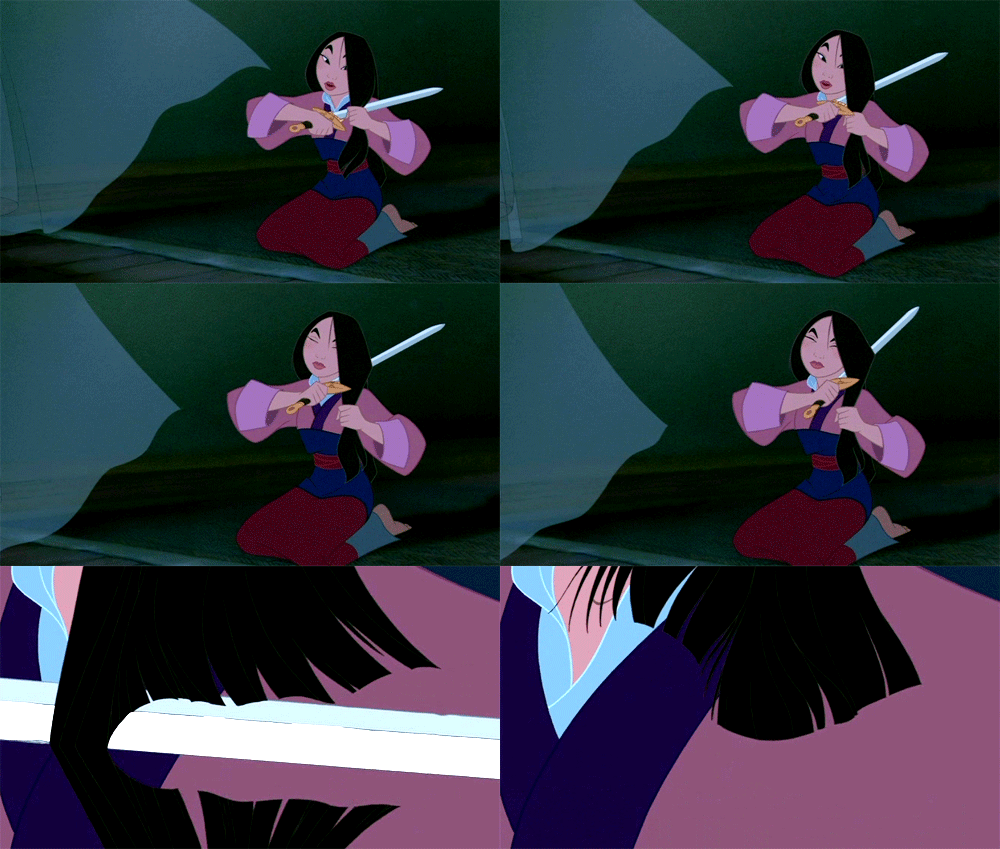
Mulan
Lady Macbeth would love this movie because Mulan does what Lady Macbeth wishes she could do: Mulan turn into a guy. Lady Macbeth's famous speech reveals that she herself wishes she could turn into a man so she could commit murder. Lady Macbeth would be able to connect with Mulan because of their identical strong willpower to do what they want and not let others stop them.


How to Get Away with Murder
Lady Macbeth would originally watch this to figure out how she could get away with the murder of King Duncan. However, she would continue watching as the plot thickens in the show, as well as in her own life. Lady Macbeth would love the drama that begins occurring in the life of Viola Davis and would use it to escape the guilt she is beginning to feel about the murders she has helped commit.


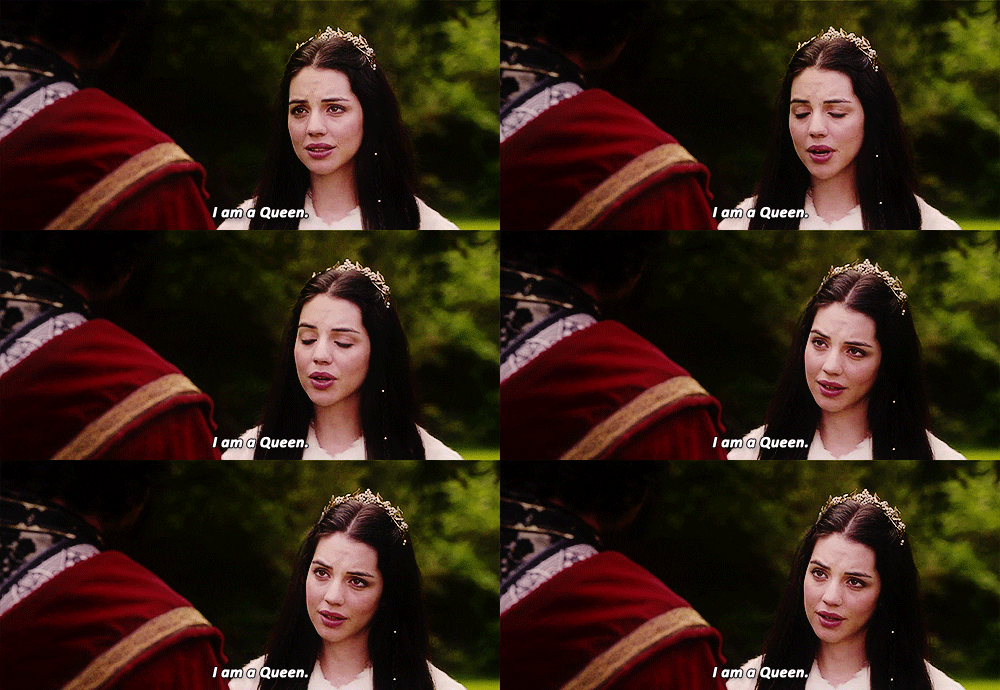
Reign
Lady Macbeth would love this show because of the strong female character of Queen Mary, but also because of the stories of royalty. The love triangle in the show would amuse Lady Macbeth, but the real appeal would be the character of Queen Mary herself. Queen Mary is very decisive and makes sure she gets what she wants, just like Lady Macbeth.


Legally Blonde
Elle Woods would be Lady Macbeth's favorite character ever. Lady Macbeth would adore Elle's independence and her ability to do anything and everything a man could do. Elle does this all while keeping her femininity as well. Elle even gets into Harvard Law School! She does this and more which Lady Macbeth would love to do.


Leap Year
Once again, the strong female character of Anna Brady would appeal to Lady Macbeth. Anna Brady takes life into her own hands when she goes to Ireland to propose to her boyfriend. This gets interrupted by a handsome stranger she meets along the way. It is very obvious that Anna wears the pants in her relationship, just like Lady Macbeth does in her marriage to Macbeth.